

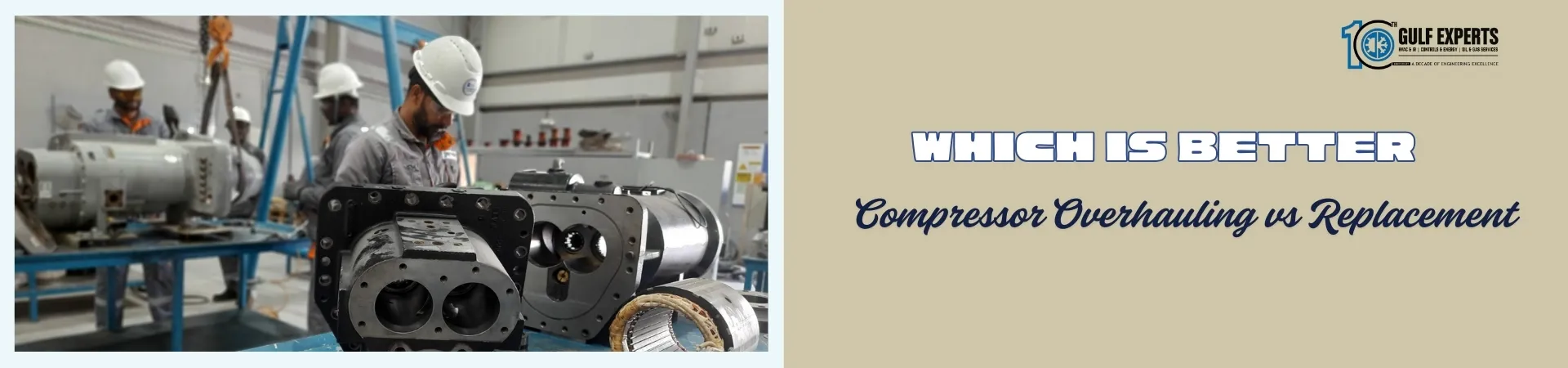
When an industrial compressor starts failing, the decision isn’t always simple. Should you invest in compressor overhauling, or is it time for a full replacement?
For industrial facilities, this decision impacts productivity, downtime, maintenance budgets, and long-term reliability.
In this guide, we’ll compare compressor overhauling vs replacement, explain how to choose the best option for your application, and highlight the most cost-effective way to restore performance without risking unplanned shutdowns.
Industrial compressors operate under high pressure and continuous load, often in harsh working environments. Over time, this leads to issues such as:
You can read these articles: 5 must-know signs your chiller needs maintenance
Ignoring early warning signs can turn a repairable issue into a major system failure.
👉 If your compressor performance is dropping, a professional evaluation helps determine whether overhauling or replacement is the smarter investment.
Compressor overhauling is a deep service process that restores a compressor’s performance by repairing, replacing, and reconditioning worn components. It typically involves:
Overhauling is often the best choice when the compressor is structurally sound, and the issue is isolated to serviceable parts.
Compressor replacement means installing a new compressor unit (or a complete upgrade) to replace the existing system. It’s usually considered when:
Replacement can reduce long-term risk, but the initial cost and installation requirements are often higher.
Overhauling usually costs less than replacement, especially if the issue is wear-related and the compressor structure remains healthy.
Replacement may require:
Overhauling can often be scheduled faster and completed with less disruption—especially when planned before a full breakdown occurs.
Replacement can take longer due to:
If uptime is critical, industrial facilities often use temporary solutions while major work is underway.
A properly overhauled compressor can deliver strong performance and reliability for years—especially when combined with preventive testing and monitoring.
However, if the compressor is near end-of-life, replacement may offer better long-term stability.
Older compressors often operate at lower efficiency. If energy costs are a major concern, replacing an outdated unit may improve consumption and reduce operating expenses over time.
For facilities focused on optimization, combining maintenance upgrades with an energy audit can help validate the best path forward.
Compressor overhauling is usually the better option when:
Preventive diagnostics can confirm this decision early.
Replacement may be the better solution when:
If your facility needs uninterrupted performance, replacement may reduce risk and stabilize long-term operations.
In oil and gas operations, compressors often work under demanding conditions that increase mechanical stress. In these environments, choosing the right service approach matters even more.
If you operate compressors in oil & gas applications, explore our specialized solutions
In many compressor repair and overhauling projects, precision machining plays an important role—especially when restoring worn surfaces or ensuring proper fitment.
Gulf Experts supports industrial maintenance needs with machining services such as:
These services help improve repair quality and extend equipment life.
Gulf Experts supports industrial facilities with reliable maintenance and mechanical solutions, including:
✅ Request professional compressor service support here:
There’s no single answer for every facility when choosing between compressor overhauling vs replacement.
If your compressor is structurally healthy and the issues are serviceable, overhauling can deliver strong performance at a lower cost. But if failures are recurring, efficiency is poor, or parts are no longer available, replacement may be the safer long-term investment.
📲 Need expert advice before making a decision?
Contact Gulf Experts on WhatsApp to assess your compressor condition and recommend the best solution.
If you notice abnormal vibration, increasing oil contamination, reduced performance, overheating, or frequent shutdowns, it may be time for compressor overhauling. A professional inspection confirms the best solution.
In most cases, yes. Overhauling is generally more cost-effective when the compressor body is in good condition and only internal components require servicing.
The duration depends on compressor type, damage level, and spare parts availability. Planned overhauling typically takes less time than replacement projects that require procurement and installation.
Yes. Oil analysis helps detect early wear, contamination, and lubrication issues—allowing facilities to act before major damage occurs.
Replacement is usually recommended when the compressor has repeated failures, severe internal damage, low efficiency, or obsolete parts that are no longer supported.