
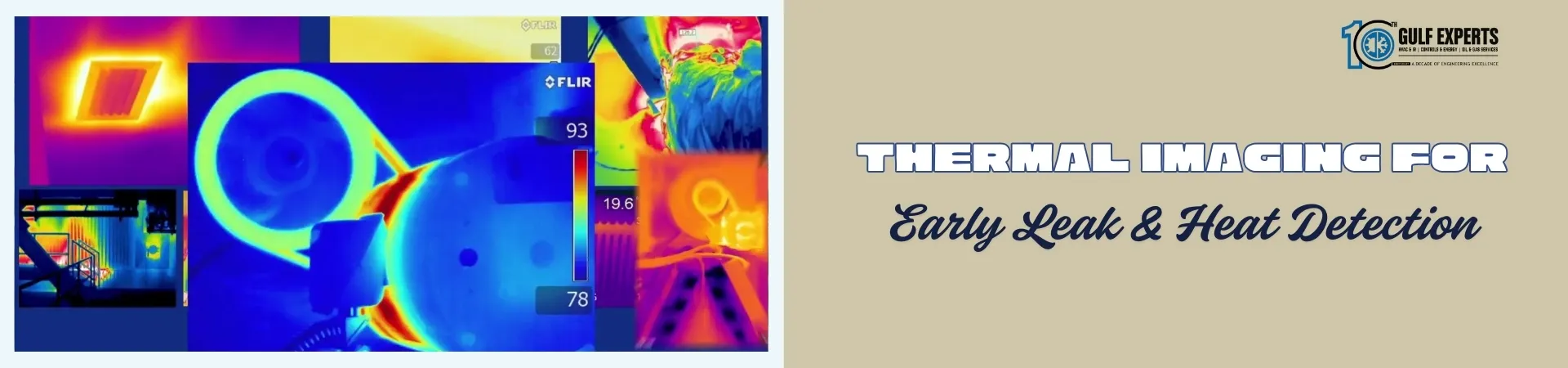
Introduction: In a complex industrial facility, what you can’t see is often what costs you the most. A “minor” air leak behind a concrete wall or a “slight” moisture buildup inside a ceiling duct can snowball into a catastrophic system failure. Thermal Imaging for HVAC isn’t just a modern gadget; it’s a “diagnostic X-ray” that allows engineers to identify thermal anomalies before they manifest as smoke, noise, or total shutdown. At Gulf Experts, we use high-resolution infrared technology to transform invisible heat signatures into actionable maintenance data.
Air leaks are energy thieves. By detecting temperature differentials, we can pinpoint where conditioned air is escaping, long before it affects your room temperature.
Water leaks inside insulation or ductwork are the primary cause of Indoor Air Quality issues. Thermal cameras detect “cold spots” that indicate moisture long before dampness becomes visible to the naked eye.
Loose connections or overloaded circuits generate heat. We scan your BMS & Control Panels to prevent electrical fires and unplanned system trips.
We don’t just provide “images”; we provide Engineering Reports. Our thermal imaging solutions are integrated with a suite of predictive tools—from Oil Analysis to NDT Testing—to give you a 360-degree view of your facility’s health.
Stop Guessing, Start Seeing Relying on traditional maintenance means you are always one step behind the problem. Thermal imaging puts you ahead. By detecting leaks, hotspots, and moisture early, you don’t just save on repairs—คุณ save your facility from the cost of unexpected downtime.
Request a Thermal Scan on WhatsApp | Explore our full Diagnostic Suite.
Thermal imaging can detect air leaks, moisture intrusion, insulation failure, overheating electrical components, and abnormal mechanical heat buildup.
Yes. Thermal imaging highlights abnormal temperature zones that often indicate duct leakage or insulation gaps, especially when combined with duct pressure testing.
Indirectly, yes. By detecting moisture intrusion and hidden leaks early, thermal imaging helps prevent microbial growth and IAQ degradation.
Most facilities perform thermal imaging annually or during major HVAC commissioning, maintenance cycles, or when performance issues are suspected.
Yes. Combining thermal imaging with vibration analysis and airflow balancing provides a stronger predictive maintenance approach.