
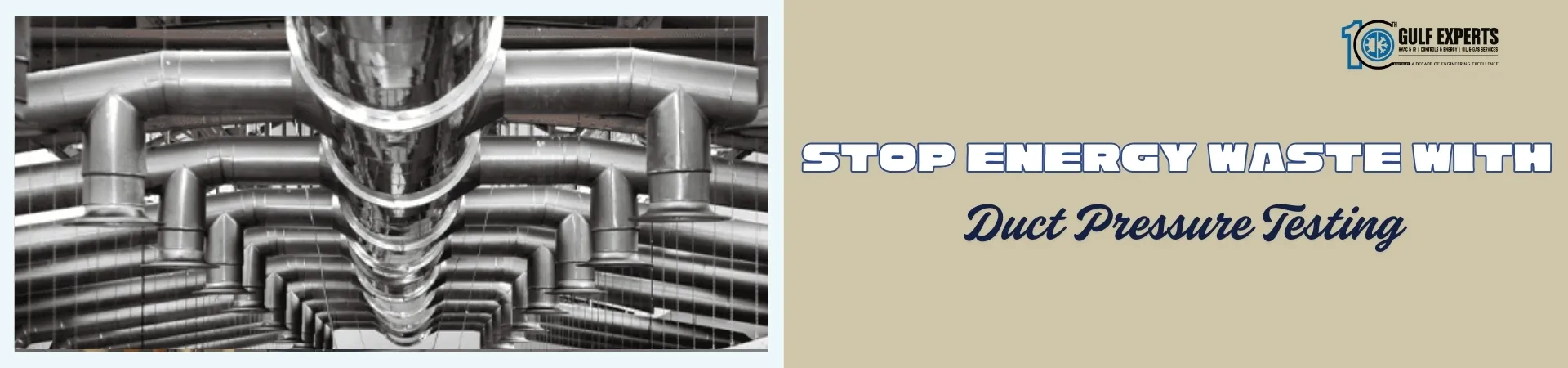
A leaking duct isn’t just a minor issue; it’s a “silent thief” draining your energy budget and killing your HVAC efficiency. Air duct systems are a critical part of HVAC performance in industrial and commercial facilities. Even small leaks or improper sealing can lead to major energy losses, airflow imbalance, and reduced indoor comfort.
That’s why duct pressure testing is an essential step in HVAC installation, commissioning, and maintenance. It verifies ductwork integrity. At Gulf Experts, we provide high-precision testing that ensures your system complies with international standards
Duct pressure testing is a diagnostic procedure used to measure air leakage in ductwork by pressurizing the system and evaluating how well it holds pressure.
The test helps determine whether ducts are properly sealed and can deliver the required airflow without significant pressure losses.
Most industrial facilities lose up to 20-30% of conditioned air through faulty duct joints. This leads to:
Duct leakage is one of the most common hidden problems in HVAC systems. Without proper testing, facilities may experience:
By identifying and sealing leaks, you reduce the load on your fans and motors. This is often the first step we recommend before an Energy Audit to ensure maximum ROI.
Successful Water and Air Balancing is impossible if the ductwork is “leaking like a sieve.” We ensure every CFM (Cubic Feet per Minute) is accounted for.
Leaky ducts force Motors and Pumps to run at higher RPMs, leading to premature bearing failure and winding burnouts.
Leaky ducts waste conditioned air, forcing HVAC equipment to work harder. Pressure testing helps reduce losses and improve overall system efficiency.
Proper duct sealing is essential for achieving correct airflow distribution, especially in large industrial facilities.
When ducts leak, fans and motors operate under higher load, increasing the risk of overheating and mechanical wear.
Leaks can allow dust, contaminants, and unfiltered air to enter the system—reducing air quality in sensitive environments.
Technicians isolate duct sections and ensure all openings are sealed to prepare for accurate pressurization testing.
The ductwork is pressurized using calibrated testing equipment, and leakage rates are measured against design requirements.
If leakage exceeds acceptable limits, technicians inspect joints, seams, and connections.
Advanced diagnostic tools such as thermal imaging can help locate hidden leaks.
Once leaks are corrected, retesting ensures compliance and verifies improved duct integrity.
A professional duct pressure test includes documented results, leakage values, and compliance confirmation for commissioning records.
Duct pressure testing is often required to meet HVAC performance and commissioning standards. Common industry references include:
Compliance ensures that duct systems operate safely, efficiently, and in accordance with design intent.
While duct pressure testing focuses on leakage and airflow integrity, duct cleaning focuses on removing dust and contaminants inside the duct system.
Both services play an important role in HVAC reliability.
Gulf Experts supports industrial and commercial facilities with professional HVAC testing and commissioning services, including:
Duct pressure testing is one of the most effective ways to ensure HVAC ductwork integrity, reduce energy waste, and improve airflow performance. For industrial facilities, it is a key step in commissioning, compliance, and long-term system reliability.
Need duct pressure testing for your facility?
Contact Gulf Experts on WhatsApp today to request professional HVAC testing support.
It is used to measure duct leakage, verify sealing quality, and ensure ducts can deliver airflow efficiently without major losses.
It is typically performed during HVAC installation, commissioning, major duct modifications, or when airflow issues are suspected.
Common standards include SMACNA leakage classes, ASHRAE guidelines, and project commissioning requirements.
Leaky ducts waste conditioned air, increase energy consumption, and create airflow imbalance—forcing HVAC equipment to work harder.
Yes. Thermal imaging helps identify hidden leaks and abnormal airflow zones that are difficult to detect visually.