
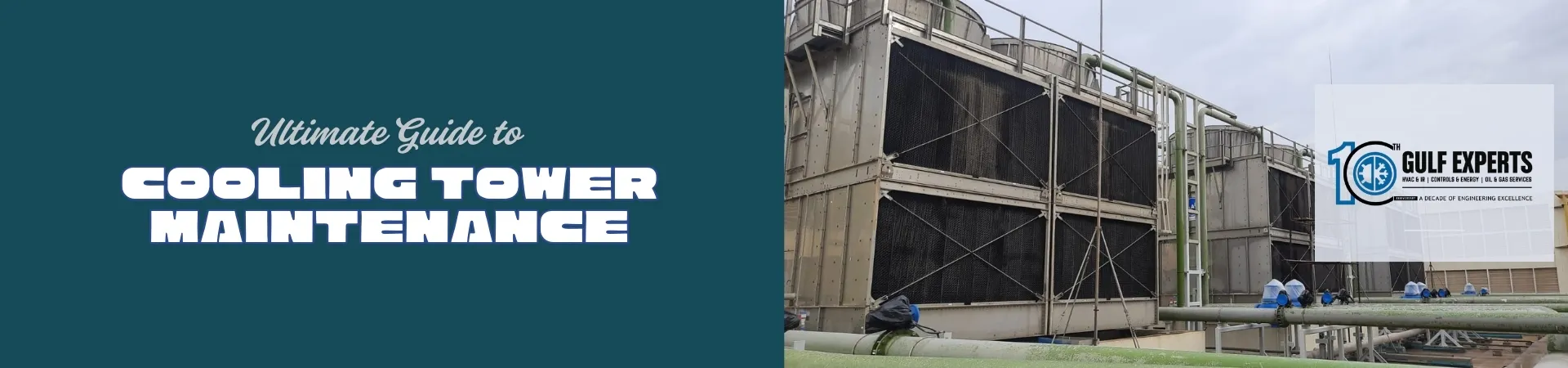
In heavy industries, a cooling tower isn’t just a component; it’s the heart of your thermal management, supporting heat rejection and stable cooling performance for HVAC and process systems. But when cooling tower maintenance is neglected, the result is often reduced efficiency, higher energy costs, frequent equipment breakdowns, and catastrophic system failures. At Gulf Experts, we’ve seen how proactive care transforms operational costs.
In this guide, we cover proven cooling tower maintenance best practices for industrial facilities—helping you improve system reliability, protect critical equipment, and extend the lifespan of your cooling infrastructure.
In harsh industrial environments, cooling towers operate under extreme thermal loads while being constantly exposed to dust, water contaminants, and aggressive operating conditions. Without professional maintenance, even minor issues can quickly escalate into major operational risks.
A structured cooling tower maintenance program helps industrial facilities maintain stable cooling performance, protect critical assets, and ensure long-term operational reliability.
Hard water is the enemy. As water evaporates, minerals stay behind, forming a rock-hard layer that chokes your heat exchange.
💡 Pro Tip: Regular Water Analysis is your first line of defense.
Unbalanced water chemistry can cause corrosion in the cooling tower structure, piping, and connected equipment—leading to leaks and long-term reliability issues. We recommend periodic Non-Destructive Testing (NDT) to ensure structural integrity without stopping operations.
Cooling towers provide ideal conditions for biological growth, especially when water treatment is insufficient. This reduces efficiency and increases health and operational risks. This isn’t just an efficiency issue; it’s a health hazard that requires specialized Water Flushing & Chemical Treatment.
Fan imbalance, misalignment, or worn bearings can create abnormal vibration, noise, and reduced airflow—resulting in poor tower performance and potential mechanical damage. Early detection via Vibration Analysis can save you from a total motor blowout.
A routine inspection checklist should include:
Early detection reduces unexpected downtime and prevents larger failures.
Cleaning removes sediment, debris, and biological buildup that reduce heat transfer efficiency. Regular cleaning improves performance and protects downstream equipment such as chillers and heat exchangers.
Water quality is one of the biggest drivers of cooling tower efficiency. Poor water chemistry often leads to scaling, corrosion, and microbial growth.
Routine water analysis helps facilities track risk factors and apply corrective actions before major performance loss occurs.
Cooling tower fans and motors must operate smoothly to maintain airflow and heat rejection performance. Facilities should monitor:
When motor performance is affected, repair support may be required.
Cooling tower performance depends on stable circulation. Pump issues can reduce flow and cause unstable system operation.
Thermal imaging can support maintenance by identifying:
Cooling towers play a major role in the efficiency of water-cooled chillers. When a cooling tower loses performance, chillers work harder to deliver the same load—leading to higher energy consumption and frequent faults.
While schedules vary based on facility demand, a practical maintenance approach includes:
Facilities operating in harsh climates or heavy industrial loads may require more frequent checks.
Gulf Experts supports industrial facilities with professional cooling tower solutions designed to improve performance and reduce downtime, including:
Cooling tower maintenance is not just routine cleaning—it’s a performance protection strategy. By following best practices such as water analysis, scheduled cleaning, vibration monitoring, and mechanical inspections, industrial facilities can improve heat rejection efficiency and prevent avoidable breakdowns.
📲 Need cooling tower maintenance support? Chat with a Gulf Experts Engineer on WhatsApp or Request a Site Inspection.
FAQ About Cooling Tower Maintenance
Most industrial facilities should perform basic inspections weekly and schedule deeper preventive maintenance monthly or quarterly. The frequency depends on operating load, water quality, and environmental conditions.
Common problems include scaling, corrosion, biological fouling, clogged water circulation, fan vibration issues, and reduced heat rejection performance.
Water analysis helps detect chemical imbalance and contamination that lead to scaling, corrosion, and biological growth. It supports corrective action before system efficiency drops.
Yes. Vibration analysis helps detect imbalance, misalignment, and bearing wear early—reducing the risk of sudden fan or motor failure.
Cooling towers support heat rejection for water-cooled chillers. If tower efficiency drops, chillers consume more energy and may fail to maintain the required cooling load.